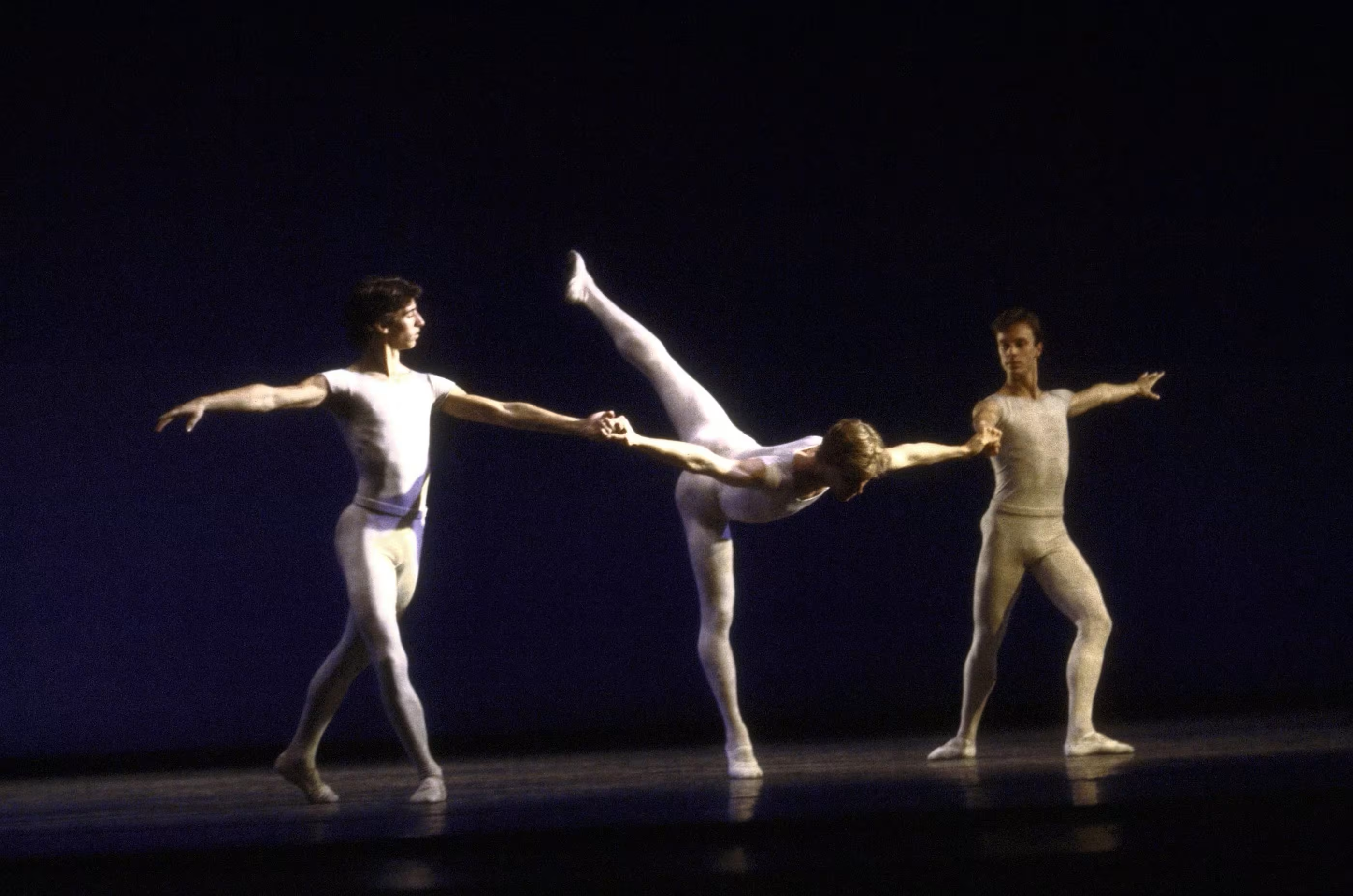

PhotoQuiet City (Woetzel, La Fosse, Boal, 1986) © Martha Swope. Courtesy of the Billy Rose Theatre Division, New York Public Library for the Performing Arts
Set to Copland's elegiac nocturne for trumpet, English horn, and strings, this spare and meditative work evokes the solitude of city life after dark. Quiet City is Robbins in his most introspective mode — still, searching, and suffused with a longing that the music both voices and contains.
Choreography: Jerome Robbins
Music: Aaron Copland
Costume Design: Barbara Matera
Lighting Design: Jennifer Tipton
12 dancers:
Principals: 3 men
Corps: 3 women, 6 men
“In Quiet City, we see two groups of shadowy men and women….Their lives are implicitly affected by the brief passage on earth of an angelic, golden-haired young man, partnered by two attendants. He expires at the end, and when he leaves, the beam of light that illuminated the initial darkness disappears as well….The saving grace lies in the music, and Mr. Robbins has chosen wisely….If we hear the sadness and elegiac elements in the score today, their relevance to the subject Mr. Robbins has chosen is clear.”
“Jerome Robbins, in his quietest and simplest work yet, has produced an unqualified masterpiece.”
“This is not a dramatic ballet, but simply a poetic, memorial statement. It has something in common with Robbins’s recent elegiac masterpiece In Memory Of…….This choreographic metaphor of visitation and death is typical of Robbins’s oblique manner of embodying drama into dance’s substance….It could have been as cloyingly sentimental–although as sincere–as carved cherubs on an ornamental gravestone….What saves it from such excess is Copland’s succinctly somber music, almost as suggestive of the meanness of city streets as Rodeo is of the open Western plains, and Robbins’s lyrical choreography with his astonishing sense of theater.”
“Robbins has had the artistic tact to cast as its hero Robert La Fosse, a newcomer to the company who was never Joseph Duell’s colleague, and to make the piece brief and simple….La Fosse, who shares a quality of boyishness with the late dancer, without possessing Duell’s gentleness or his refinement, is cast as an angel of sorts–an inspiration and guide….He is an insecure angel, however, who tends to falter at the very peak of his flights, relying for support on two lesser angels. These are danced by a pair of lyrical young men of great promise, Peter Boal and Damian Woetzel.”