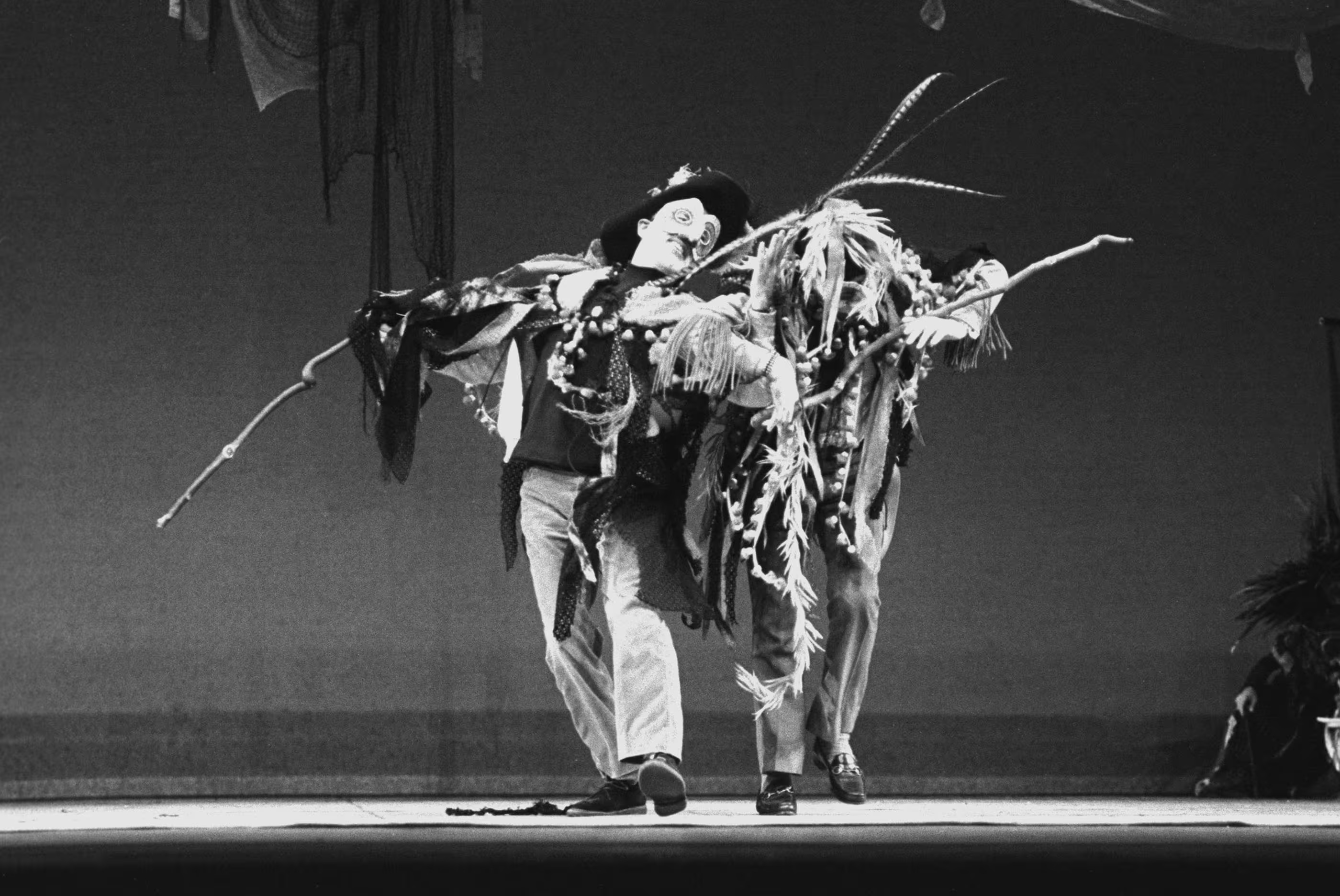


PhotoPulcinella (Robbins, Balanchine, 1972) © Martha Swope. Courtesy of the Billy Rose Theatre Division, New York Public Library for the Performing Arts
A grand commedia dell'arte spectacle in the tradition of Diaghilev's Ballets Russes, co-choreographed with George Balanchine and staged with Eugene Berman's elaborate designs. Stravinsky's Neapolitan romp provides the backbone for a carnivalesque tableau full of trickery, disguise, and theatrical excess.
Choreography: George Balanchine and Jerome Robbins
Music: Igor Stravinsky
Costume Design: Eugene Berman
Lighting Design: Ronald Bates
Set Design: Eugene Berman
56 dancers:
Pulcinella: 1 man
Girl: 1 woman
Pulcinella’s Father: 1 man
Devils: 2 (the second for stage trickery)
Concubines: 2 tall men
Little Boy: 1 boy
Policemen: 2
Beggars: 2
Musicians: 6
Townspeople: 12 or 14 (at least 7 women, 5 men)
Pulcinellas: 24 (2 ringleaders, 12 children, 10 men)
Special Cast Requirements
1 soprano, 1 tenor and 1 bass vocalist
“Last night, with something of that sense of frenzied frivolity that has so joyously pervaded this Stravinsky happening, Mr. B. and Mr. R. themselves pranced on stage in the humble, but attention-grabbing roles of beggars. Masked, looking more Mexican folk-dancers than commedia dell’arte figures, these two had a grand old time. They deserved it….They were dancing in the world premiere of Pulcinella, a ballet they themselves had co-choreographed, and almost certainly the most elaborate work of the festival….The ballet recalled to me in its spirit Mr. Balanchine’s Tyl Eulenspiegel of twenty years ago.”
“The partnership of George Balanchine and Jerome Robbins, the ballet world’s two top choreographers, was the news last night….The pair got together not only to create a new Pulcinella, but to dance in it as well. It was great fun on both counts….They may not win any awards for their performance, but their audience loved them for it. Disguised as beggars, they merely hopped around and took a few swats at each other–adding their signature to the background in much the way Alfred Hitchcock does in his films.”
“The Balanchine-Robbins-Berman-Stravinsky-Pergolesi Pulcinella was a great sloppy, bawdy concoction that must have been fun to perform and certainly was fun to watch. There seemed to be hundreds of Pulcinellas, roistering around in red caps, white floppy suits, beaked-nosed masks. The principal one was Edward Villella, who lumbered splendidly, and some were very small children….Oh, and in the middle of an elaborate final celebration, Robbins and Balanchine marched on as two beggars, pretended to thwack each other with big sticks, did a fumbly dance, and generally thrilled the fans.”
“Pulcinella, is a fantasy on the commedia dell’arte theater. With Eugene Berman’s cornucopia of scenery and costumes, it is difficult to know where dancing ends and production begins. I suspect that in the future costumes will be pared and the action more detailed. Yet whether the ballet will come closer to the commedia’s ribaldry and essential cruelty is questionable….Of all the new ballets, Pulcinella is in the rawest shape. It could tighten into a biting, ironic vision, or it could fatten into a stereotyped Italian fiesta.”
“Pulcinella, the big production number of the festival, with the gaudy, floppy, bangly, fringy costumes, masks, disguises, wagon stages, props, and the thoroughly ratty, cluttered atmosphere belonging to the commedia dell’arte, designed by Eugene Berman….Also notable is the duet for the co-choreographers, Balanchine and Robbins, as little old street beggars in tennis shoes, who beat each other up with their canes.”
“This Pulcinella is a ballet of character more than content, not specially distinguished in choreographic terms but a lighthearted diversion to finish a programme in good spirits, evidently intended for the company’s general repertory. It generates the ‘real southern Italian feeling’ that Balanchine said he wanted for it, and although he was quoted that he would not recommend co-choreography as a regular method of working, he felt that his collaboration with Robbins had succeeded in this instance, adding: ‘Besides, two people work faster than one.’”
“Pulcinella is a big jolly mess. With a fresh scenario about how Pulcinella outwits the Devil, it scampers through one low-comedy joke after another….A good ballet? A bad ballet? Who knows? On one viewing, it certainly was a lark. Only repeated viewings will determine whether or not its jokes are substantial.”
“The ballet is now both dark and sunny and without a consistent vision….There is a lot of milling about, which is no doubt due to lack of rehearsal time but perhaps also because Robbins and Balanchine have not figured out what the ballet should feel like….It was great fun to watch Robbins and Balanchine whack each other with sticks….Their little bit is charming for its improvisational quality, but the rest of the production seems more temporary than spontaneous, more marked than directed.”