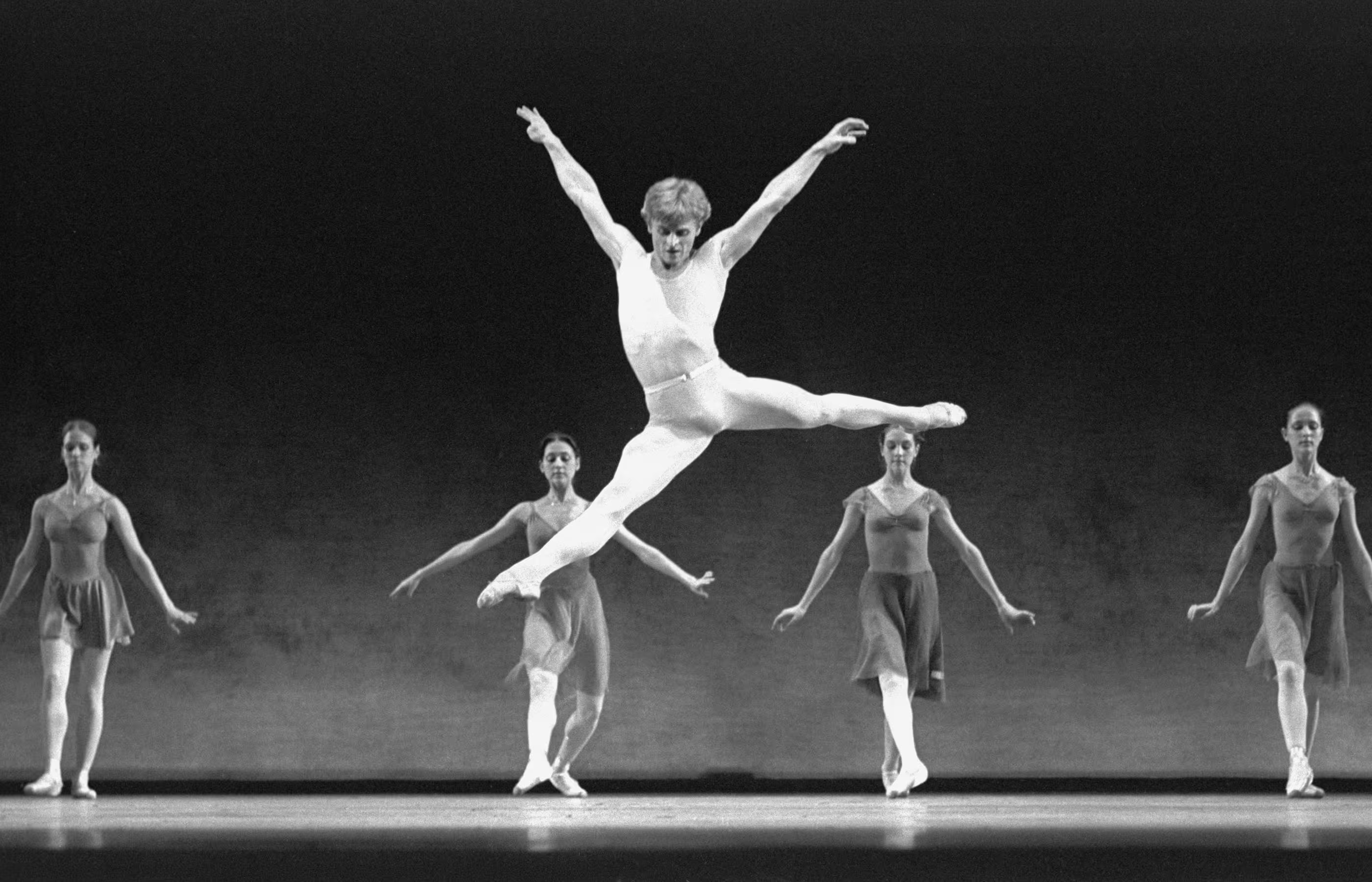

PhotoOpus 19 (The Dreamer) (Baryshnikov, 1979) © Martha Swope. Courtesy of the Billy Rose Theatre Division, New York Public Library for the Performing Arts
A lyrical and introspective work in which a singular figure — the Dreamer — moves through an ensemble as if navigating the landscape of memory or imagination. Prokofiev's rapturous first violin concerto provides an ideal vehicle for Robbins' capacity to isolate the individual within a communal dreamscape.
Special Requirements
Violin and orchestra
Choreography: Jerome Robbins
Music: Sergei Prokofiev
Costume Design: Ben Benson
Lighting Design: Jennifer Tipton
14 dancers:
Principals: 1 woman, 1 man
Corps: 6 women, 6 men
“Robbins’ choreography is nervily eloquent. It is classic, but as we so often see with Robbins, it also takes a character nuance that is almost unnoticeable in its blending….What he has achieved for Baryshnikov is remarkable. He seems to have caught that intellectual, questioning quality of Baryshnikov….This is a graceful ballet full of information about its dancers, and full of feeling for its music and its time. It is the study of a man, and a picture of a dancer. And Baryshnikov sweeps diffidently through the work like a portrait study of himself.”
“With Opus 19, Mr. Robbins returns to unspecific dramas well as some of the themes and vocabulary of his past. If one needed to state the matter in shorthand, one could say it is another of Mr. Robbins’s good neurotic ballets. And in saying so, one need hardly add that few can evoke the anxiety of an age in ballet as well as Mr. Robbins….Mr. Robbins has not created a psychological ballet in the conventional sense. To be dramatic without disclosing what there is to be dramatic about is no small accomplishment.”