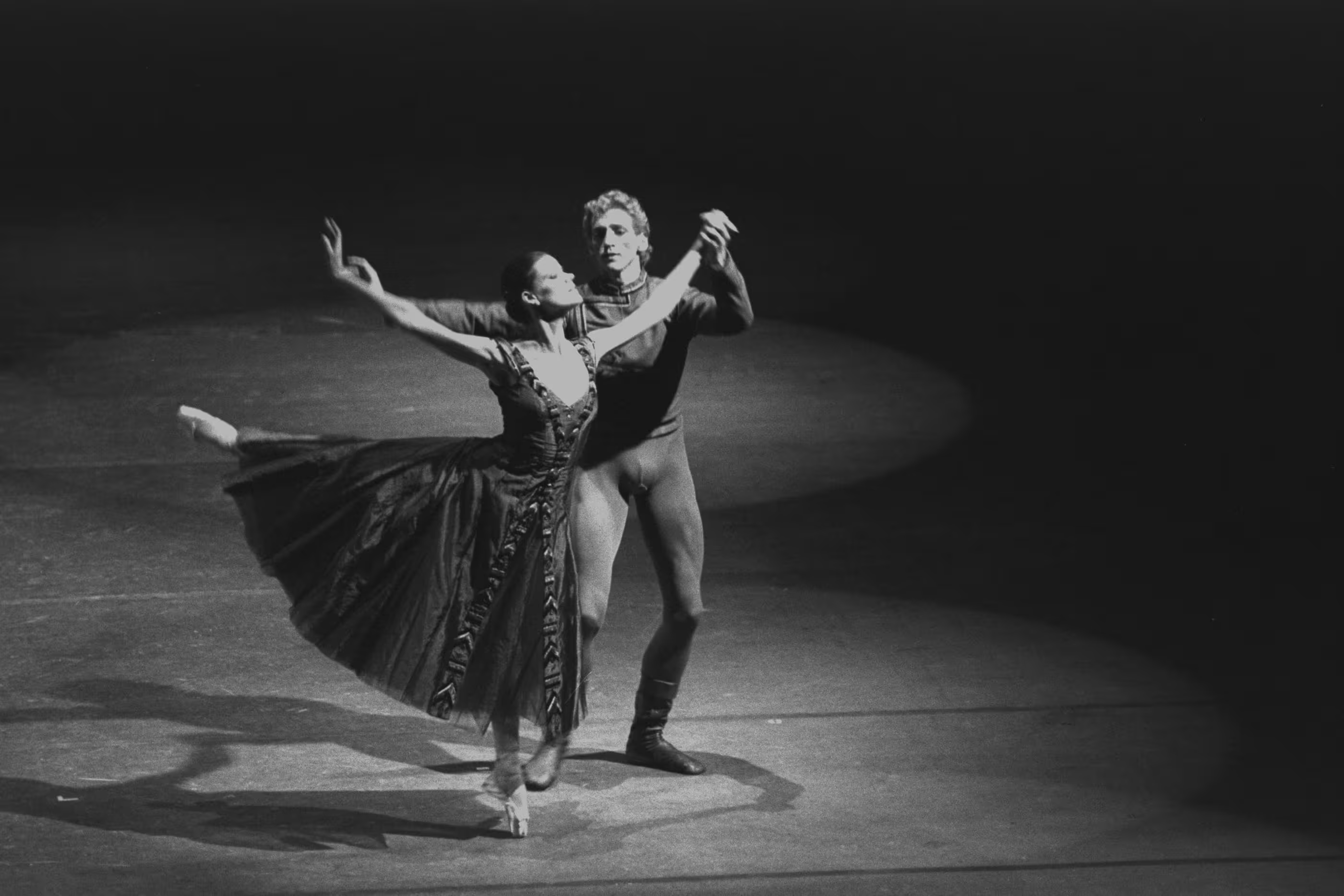

PhotoIn the Night (Ashley, Lavery, 1985) © Martha Swope. Courtesy of the Billy Rose Theatre Division, New York Public Library for the Performing Arts
Three couples, three nocturnes, three different emotional worlds — youthful passion, mature devotion, turbulent longing — gather briefly, as if meeting by chance in the night. A companion piece to Dances at a Gathering, this intimate and deeply romantic work is one of Robbins' most purely felt creations.
Special Requirements
Piano on apron
Choreography: Jerome Robbins
Music: Frédéric Chopin
Costume Design: Anthony Dowell
Lighting Design: Jennifer Tipton
Set Design: Jennifer Tipton
6 dancers:
Part I
1 woman, 1 man
Part II
1 woman, 1 man
Part III
1 woman, 1 man
“In the Night is not merely a Son of Dances at a Gathering, or Gathering Revisited; rather, it is a further extension of Robbins’s choreographic thoughts inspired by Chopin’s piano music. This work is perhaps a pendant to the earlier ballet, yet it stands by itself as very different in style, tone and texture….In the earlier piece the dancers were peasants, here they are aristocrats of that emotional Ruritania known best by poets and choreographers….There are structural differences between the two ballets as well. Here Robbins has settled for the simplest of architectural forms–three duets and a final ensemble.”
“For all its outward ease, the movement becomes immensely intricate, ever searching for new body designs, new rhythms, new transitions that complement the music….In the Night is shorter than Dances at a Gathering. I hope this doesn’t mean that Robbins has exhausted Chopin. But if he has, let’s hope he will go on to explore other music in the same way he has this.”
“Where Dances at a Gathering features ten dancers, Night uses just six: three boys and three girls. And while Dances at a Gathering is a long and relatively complicated series of pure dance episodes, Night is a shorter and unabashed outpouring of pure romanticism….One measure of Robbins’ great talent is the fact that he has made a genuinely pretty dance without a trace of sticky sentimentality.”
“The special kind of contemporary Romanticism that Robbins is interested in is expressed in dance that burgeons and branches and grows like leaves–startling, perhaps, by its eventual shape, but never seeming inorganic….The choreography serves the dancers, and they in turn serve it beautifully. Each seems completely real in what he is doing. Ballet technique disappears as artifice and becomes–as it rarely does–a means to dancing, a transparency for spirit to be seen through.”
“Being lovers, each couple dances in a self-contained world. In the final last section they meet and form a circle. During the closing moments of Dances at a Gathering, all ten dancers also form a circle, as an expression of their friendship and interdependency in the face of an unknown future. The couples of In the Night find that the circle does not work; it is an unnatural grouping of what are essentially families of two. The circle is quickly broken, and as the curtain falls the three pairs are strolling off the stage in opposite directions, into three different worlds.”
“Have you ever seen a nocturne? I have, courtesy of the choreographic magic of Jerome Robbins….The movements that Robbins has designed for his dancers do more than give body-shape to the melodic lines, the rhythms, the textures, the sonorities, the ‘breathings’ of the music. Relationships and incidents are indicated by the nocturnal figures as they travel their musical pathways in shadows or shafts of moonlight….The touchings, the pressings, the embracings of bodies are exquisitely conceived so that the whole emerges as a poem to the most natural aspects of romance.”
“Like Dances at a Gathering, there will be no end to In the Night, no end to the ways one can see it, no end to the ways it can be danced. It will always have its own brooding turbulence….Each of the three couples has the stage alone….Dances at a Gathering gave us the gentle, artless Chopin; the gentle, artless Robbins. In the Night gave us the neurotic side of both. In each context he stretched his dancers emotionally and then they found the movement to make it stick.”
“In the Night is a glorious work, just fifteen minutes long, by turns tender and passionate, full of invention and human eloquence. The dances spring from the music as naturally as the waves breaking on a seashore. There is a rightness to them, an inevitability that comes only with the very greatest of choreographers. Robbins is indisputably one of that small, small number. His output may be less than some, but in terms of pure artistry he need bow to no man.”
“In the Night is condensed and almost unbearably intense. It treats romantic relationships in three kinds of ‘nights’: the night of lovers’ trysts; the night illuminated by the lights of parties and balls; and the darkness of passion, of the storm before the calm of reconciliation.”
“With In the Night, Jerome Robbins has solved all the problems of dancing to Chopin….He never dances on the music–he dances in it; he inhabits it….Within each second of the piece, he separates the dance from the music, then the drama from the dance. When they are divided–equal to each other in dominance and power–he puts them back together again–quick; they commingle. Each–drama, dance, music–lives and breathes its own life yet, at the same time, each mysteriously enhances and blends with the other like the alternating, whispered statements and parentheses of talky lovers.”