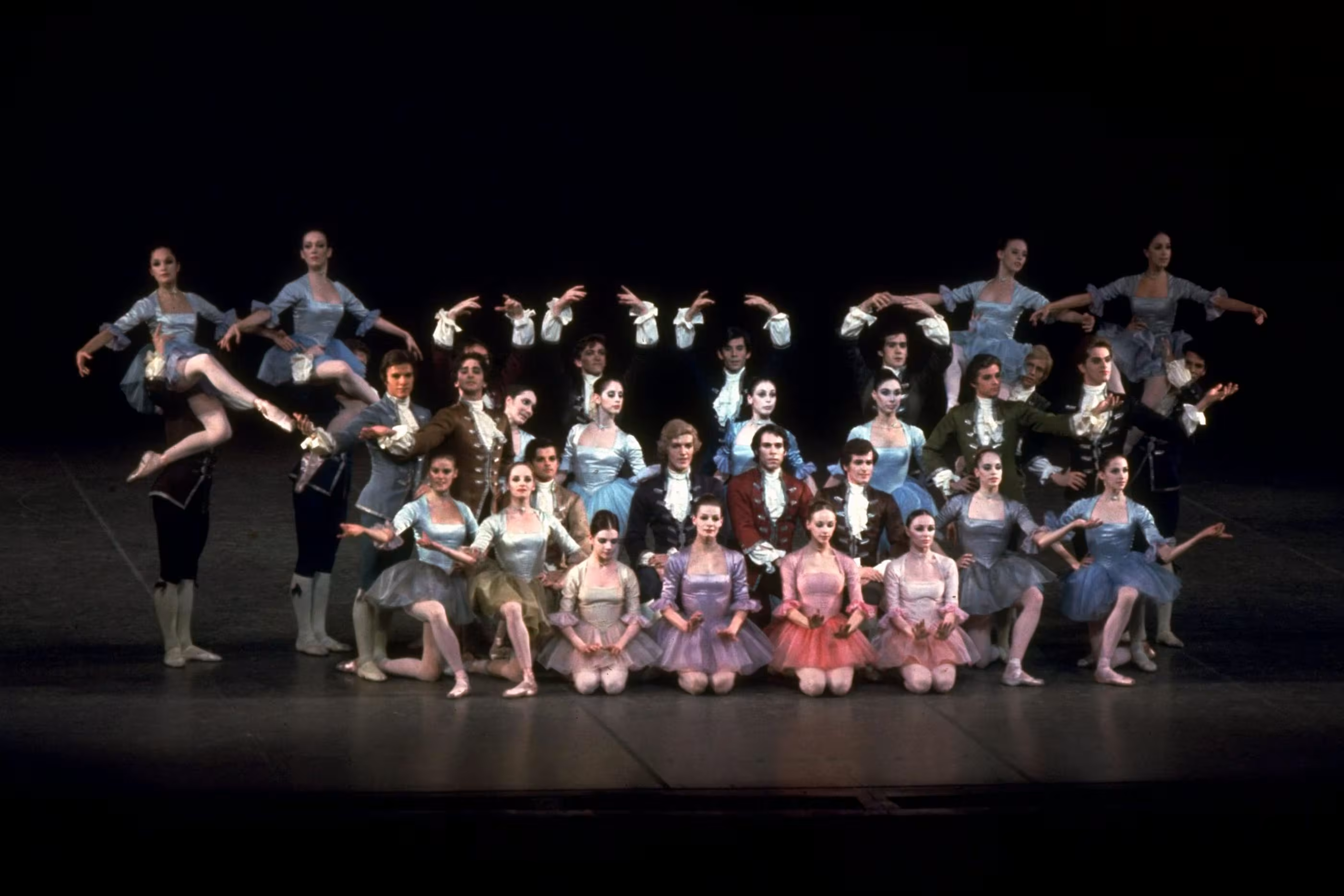


PhotoGoldberg Variations (NYCB, 1971) © Martha Swope. Courtesy of the Billy Rose Theatre Division, New York Public Library for the Performing Arts
A monument of American choreography, this 75-minute meditation on Bach's Goldberg Variations unfolds in two grand parts: the first spare and monochromatic, the second lush and full. Forty-seven dancers inhabit thirty variations ranging from solos of almost naked simplicity to ensemble celebrations of collective brilliance.
Special Requirements
Piano on apron
Choreography: Jerome Robbins
Music: Johann Sebastian Bach
Costume Design: Joe Eula
Lighting Design: Jennifer Tipton
39 dancers:
Theme
1 woman, 1 man
Variations, Part I
9 women, 9 men
Variations, Part II
14 women, 5 men
“The choreography is coolly inventive, intellectual rather than emotional. The dancers are used more as musical instruments than people, and whether boy dances with girl or boy doesn’t much matter….As the variations get livelier, the dress changes, to simple peasant style and the movement is sprightlier, until finally it becomes freer and wittier and more modern.”
“One has to give this much to Mr. Robbins–there are very few other choreographers who would have even attempted such a ballet….That he has made a cohesive dance of nearly an hour and a half in length, and that he has had the courage to set it to the majestic Goldberg Variations for keyboard of J.S. Bach is certainly to his credit. If his new ballet falls short–far chart, at times–of excellence, perhaps it is because not even a superior artist like Jerome Robbins can be expected to fully realize such an ambitious undertaking.”
“The Goldberg Variations may well be the longest continuous dance work we have, running an hour and a half. It’s worth every minute….Robbins’ way with the variations is continually surprising. Sometimes his approach is delightfully literal, as in the rippling opening to one variation, which brings the massed girls tripping on from the wings like a sudden splattering of raindrops. At other times, he will take an especially rapid variation and play against it with an almost slow-motion pas de deux….There is simply too much here to be considered in a single viewing.”
“Jerome Robbins’s new ballet is a work of such amplitude and grandeur that it can make you fall in love with the human body all over again. What a piece of work is man! And with what ballets does Mr. Robbins celebrate that workmanship!….The mastery of Robbins you take for granted–the grand and exploratory pas de deux, where two human bodies seem embarked on a kinetic, asexual adventure, adventures that human bodies rarely attempt without losing their humanity. The humanity of Robbins–this is the fantastic thing you always notice….Any choreographer can show lovers–Robbins can show people.”
“Once in a long, long while, a master creates a work of art as perfect as a snowflake, as logical as a leaf. Jerome Robbins has made such a work with The Goldberg Variations to the music of Bach. It is a study in structure and history. It is one of the great ballets of our time….With this ninety-minute work, Robbins has defined contemporary American ballet.”
“The new work is a magnificent spectacle, involving a large number of dancers. It does not throw virtuosity at you as the classical ballet does. The virtuosity is there, nevertheless, concealed (or, rather, understated) behind a fluency of sequence that is a total delight. One of the most interesting and innovative things about this new kind of choreography is Robbins’ use of stage space. His arrangements of dancers are seldom symmetrical….The première of The Goldberg Variations was to me the high point of a busy ballet season, and it places Mr. Robbins among the great, original masters of the art.”
“No lesser descriptive than ‘enduring masterwork’ quite sums up the wonders of The Goldberg Variations. Here a great creative influence again exceeds his own former high reputation, and this within the chaste bounds of Bach’s 18th century keyboard music….On first viewing, this ninety-minute triumph seemed less consistent in quality and less coherent than Robbins’ masterpiece Dances at a Gathering. But a second viewing not only confirmed the view that Goldberg Variations is a pinnacle of 20th-Century art, but gave rise to the notion that it may be the most perfect dance work ever made.”
“The Goldberg Variations is a sumptuous banquet of dance, almost a surfeit; perhaps one should fast for a few weeks before seeing it….I have to say that, although The Goldberg Variations is intricate and intellectual both in intent and form, that although it has high points and lower ones, I was moved to tears by it and am again now–just thinking of the overwhelming richness and beauty of all that dancing.”
“The Goldberg Variations runs unbroken for eighty minutes–one of the longest non-story ballets ever produced. It demands, and successfully commands, total attention through sheer mastery of what choreography can create for the human body to perform. Time and again Robbins presents familiar patterns and movements that somehow give the impression that they have never been danced before….Almost inevitably, The Goldberg Variations invites comparison with Robbins’ Dances at a Gathering….Clearly, though, Dances is in every sense a Romantic work–open, playful, exuberant, instantly approachable. Variations is far more formal and classic, and far more demanding as well.”
“The Goldberg Variations, though cool, is not cold, and there is a graciousness to it, touched with shining moments of wit, that is captivating. How to describe it? It is classical ballet in form and usually in step, but there is a freedom of choreographic invention that carries it beyond ballet into total dance….The length, for most of us, is felt, but the ballet never bogs down, and the unhurried pace of an earlier age comes as a gratifying experience.”
“The most amazing and lovely point about The Goldberg Variations is its translucency. Watching it is like listening to Bach. Every movement is weighty and isolated and yet musically dramatic in its relationship with other movements….It is exhausting, as well as exhaustive, because there is so much to see and because it won’t allow for a moment’s vacation. Also, it is apparent from the beginning that a structure exists. Its unfolding increases attentiveness and generates a sense of anticipation….Like all travel that takes you everywhere but returns you to your doorstep, The Goldberg Variations is exhilarating and, ultimately, immensely satisfying.”
“Robbins has succeeded in casting new light on a great piece of music….The prime force that keeps the attention riveted on the stage during this ninety-minute abstract ballet is Robbins’ enormous skill in creating steps and patterns that combine extreme naturalness with high art….Nothing is forced, nothing goes against the grain, nothing is imposed purely for the sake of effect. And while this is all happening, the inner nature of Bach’s own genius is also being laid bare by the visual patterns on the stage.”
“To set a ballet to the entire Goldberg Variations is a project so enormous, an ambition so unusual, that one’s mind is stirred by the very thought of it….Yet Robbins has once again emerged triumphant….Its qualities touch the intellect more perhaps than the heart, but it, too, is moving in its very grandeur, celebrating it seems the variety of classic dance and themes as diverse as love, friendship and athletics.”
“One of the ballet’s most evident qualities is its absence of stated emotions; whatever anyone feels, there is no romantic urge to display it….Robbins has taken ‘classical’ to mean sanity and the capacity for relationships, and above all the capacity to create and use disorientation rather than to become its victim. This is why he has done his dance to Bach, and why the dancers accompany rather than ‘interpret’ the music. The ballet is not an interpretation of Bach; it is a reflection on a certain kind of world Bach suggests to Robbins.”
“Jerome Robbins’ The Goldberg Variations is an epic and very beautiful journey. You feel the exhilaration of having been in many new places and simultaneously feel a reassuring sense of security, for it is obvious that the trip will be smooth and will take you where you want to go. At the end a delicious fatigue sets in, for there has been much to see….The Goldberg Variations is the kind of dance dancers must dream about, or so it seems from the way they perform it.”