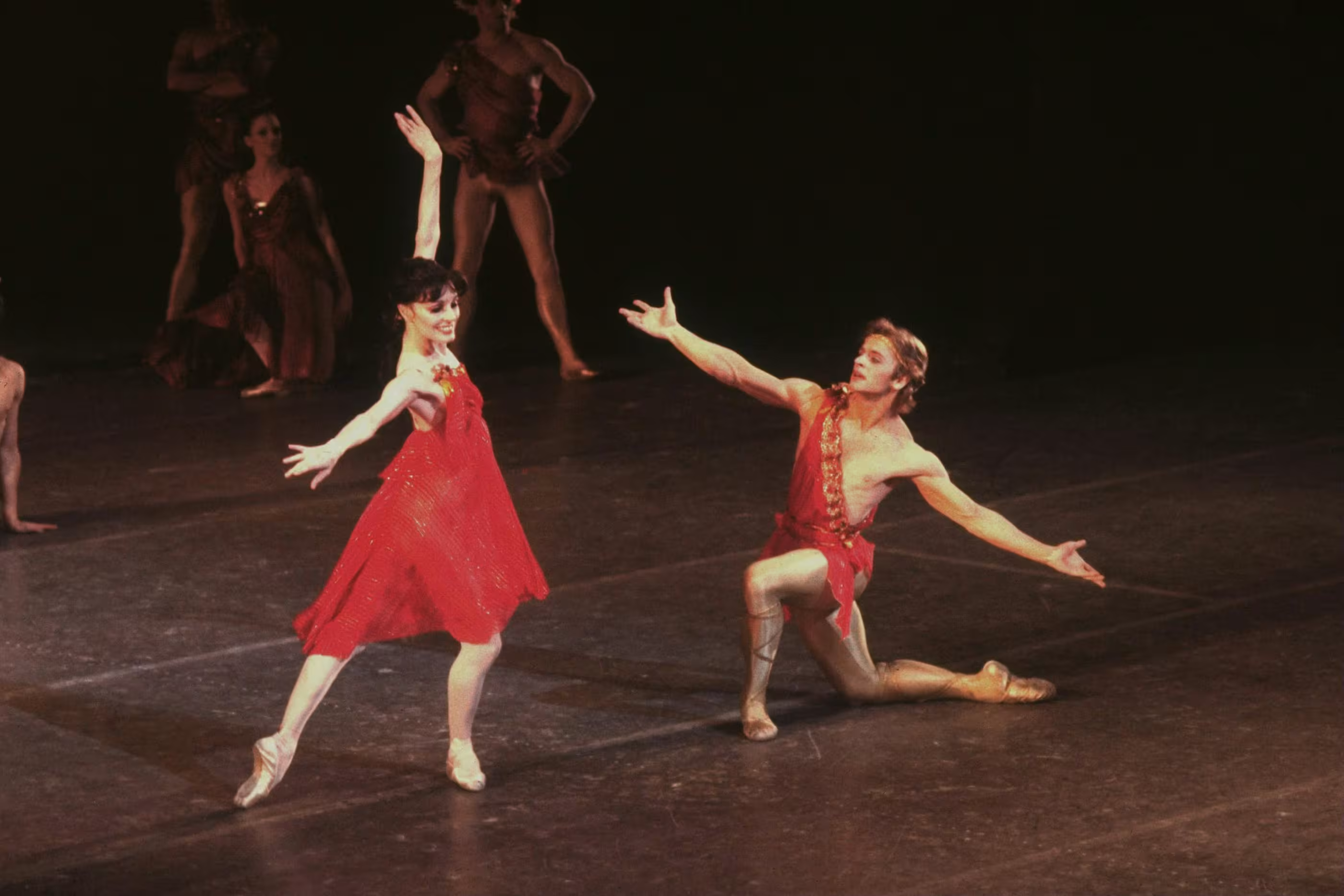

PhotoFour Seasons (McBride, Baryshnikov, 1979) © Martha Swope. Courtesy of the Billy Rose Theatre Division, New York Public Library for the Performing Arts
A spectacular pageant in four movements — Winter, Spring, Summer, Fall — drawn from Verdi's operatic ballet music. Each season is represented by an allegorical figure and a full ensemble, creating a lavish theatrical display that showcases Robbins' command of large-scale classical form.
Choreography: Jerome Robbins
Music: Giuseppe Verdi
Costume Design: Santo Loquasto
Lighting Design: Jennifer Tipton
Set Design: Santo Loquasto
31 dancers:
Janus: 1 man
Winter
Allegory: 1 man
Principals: 1 woman, 2 men
Corps: 8 women
Spring
Allegory: 1 woman
Principals: 1 woman, 1 man
Corps: 4 men
Summer
Allegory: 1 woman
Principals: 1 woman, 1 man
Corps: 6 women
Fall
Allegory: 1 man
Principals: 1 woman, 2 men
Corps: 8 women + 2 for finale, 8 men + 1 for finale
“For pure invention, wit and seamless musicality, this is the best thing Robbins, in his long career, has ever given us….This is not to knock his past–in the long issue of dance history probably many works, as diverse as Watermill or Fancy Free, will be placed ahead of this. But The Four Seasons gleams and sparkles–it is brilliant and it is fun….The ballet is consistently funny but essentially light hearted. It goes like a breeze–it never for a moment pushes its effects. The choreography is unending in its imagination.”
“The ballet is clever, even deliberately vulgar on occasion, and, in its best sections, totally inventive in its steps and flamboyant use of space. It is high-class show biz, somewhat uneven and something of a public hit….The opening suggests a masque with mythological figures that, à la Ashton, are turned into Classical ballet dancers. And when Mr. Robbins is at his most Classical, as in the first ‘Winter’ section and the superb ‘Spring’ section, he is also at his best.”
“(Robbins) has created Baryshnikov’s first really successful role at City Ballet, but his final supervirtuoso turn in ‘Fall’ is only flaming brandy on top of the whole delectable concoction….By the time the great Russian appears, we have been treated to a spectacular pas de deux for Kyra Nichols and Daniel Duell, and a quartet for four men that is pure ballet-to-Broadway Robbins, and even during Baryshnikov’s section…a tailor-made solo that utilizes the kind of impish humor that Misha seems to have lost since joining the company. He is danced almost to a standoff by Jean-Pierre Frohlich as a mischievous faun.”
“When danced by Patricia McBride and Mikhail Baryshnikov, it has a dazzle that equals the brilliant colors of turning leaves in the best of falls. The alternate cast of Suzanne Farrell and Peter Martins are given different choreography for their variations, and if the focus in this casting moves from Baryshnikov to Farrell, it is an affirmation that Robbins sets his ballets on particular dancers and choreographs to their strength.”
“It’s as if in Spring he were able to encompass only a list of must-nots. The material for Kyra Nichols and Daniel Duell is so restrained, so limpidly organized, that it looks inhibited….Summer is the shortest of the Seasons, little more than an interlude between Spring and Fall….In the final section, the allusions to ballets past are so ripe that to an audience with a decent awareness of dance history they’d be almost past mentioning….Robbins’ choreography asks Baryshnikov for everything he knows about jumps and turns….He embodies the drive to ‘do more’ and do it bigger and faster than ever.”
“It is obvious that Robbins’s intention is to give us a good time. That intention is The Four Seasons’ hallmark, I think, and something new for Robbins. Thus what would otherwise be one more delightful work in another choreographer’s gallery has an additional importance….Robbins seems to have dispensed with notions of artistic raison d’être and has gained freedom. Instead of manufacturing a concept to support choreography–in many instances to justify choreography–he lets Verdi do it for him.”
“Robbins’s sweet and deliberately naïve ballet can be taken seriously in the same way that adults can take children’s fairy tales seriously. …The ballet is surprising in many ways. Audiences who had attended the premiere received one surprise at a later performance with Suzanne Farrell and Peter Martins leading ‘Autumn,’ for they discovered that Robbins had choreographed different variations for Baryshnikov and Martins, each variation containing steps that that particular danseur could do especially well….Robbins has certainly used classical technique well in the Four Seasons and the result is a delectable confection.”