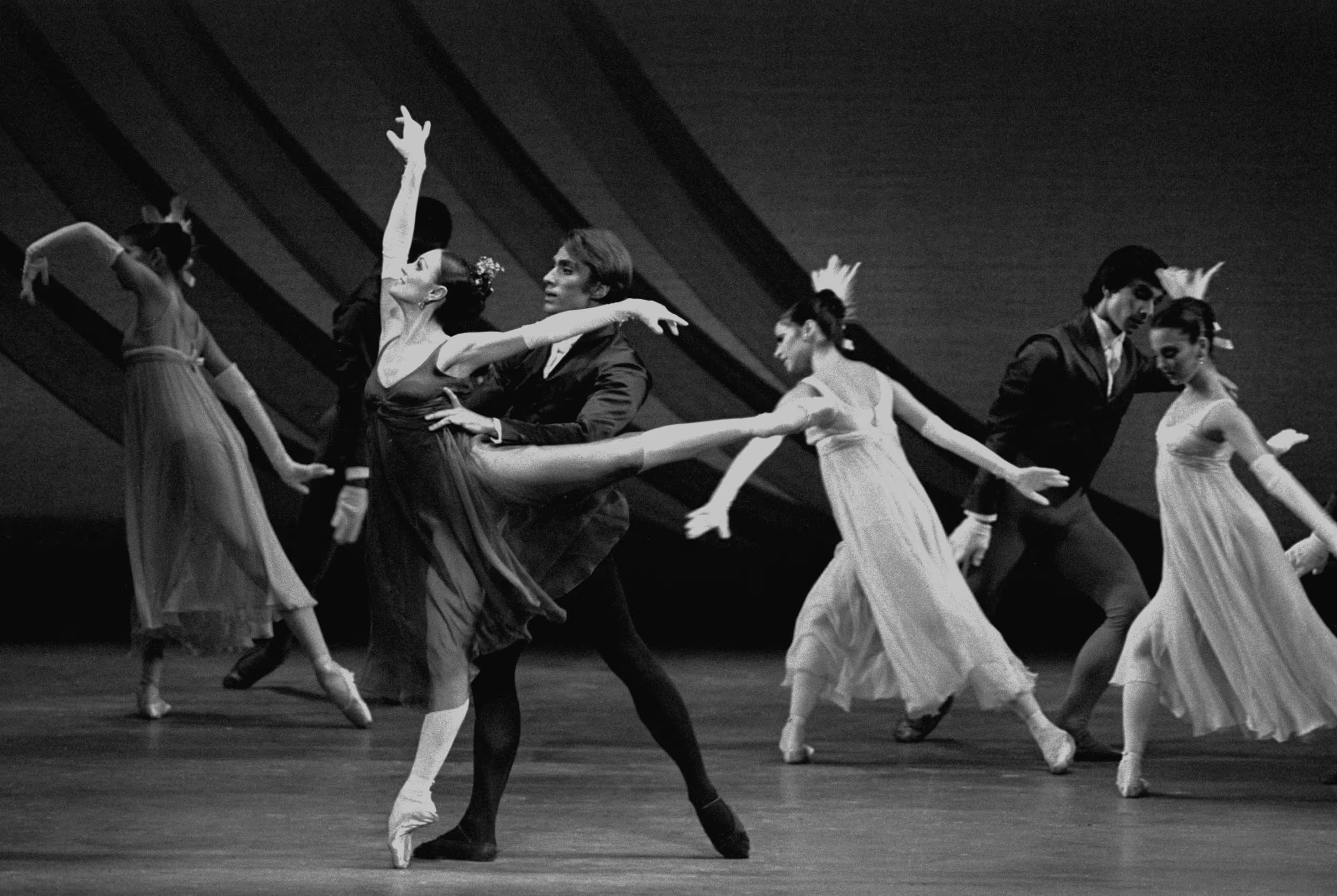


PhotoAn Evening's Waltzes (McBride, Bonnefous, 1973) © Martha Swope. Courtesy of the Billy Rose Theatre Division, New York Public Library for the Performing Arts
A lavishly romantic suite of five waltzes drawn from Prokofiev's late orchestral writing. Unfolding through a series of contrasting couples and ensembles, the ballet revels in opulent partnering, sweeping musicality, and the bittersweet elegance of the waltz form.
Choreography: Jerome Robbins
Music: Sergei Prokofiev
Costume Design: Rouben Ter-Arutunian
Lighting Design: Ronald Bates
Set Design: Rouben Ter-Arutunian
23 dancers:
12 women
11 men
“Jerome Robbins returns to the lyric romanticism of Dances at a Gathering in his new work….Although his format doesn’t allow as much chance for invention, he does search out and find new relationships, new ways for two people to move together. The result once more is unadulterated beauty….Mr. Robbins is concerned here with the lilting rhythms and an idealized ballroom image. As such, it is enchanting.”
“What it lacks is depth, a profundity which would make it something more than quality entertainment. From a lesser choreographer than Jerome Robbins, quality entertainment is perhaps all you could hope for. But Robbins is major artist, one capable of combining serious content with entertaining form….It reflects, rather than probes, the elegance of neoclassical ballet….An Evening’s Waltzes is not an exuberant ballet, nor is it apparently meant to be so. It emphasizes the sweet directness of fluid, graceful motion.”
“It does not have the strength, vigor and incisiveness that have characterized Mr. Robbins’s choreography of late. There was an individuality to works such as Dances at a Gathering, In the Night, or Goldberg Variations, which seems to be missing on this occasion….One interesting thing is that Mr. Robbins uses a rather larger ensemble than is his custom, and he uses it with considerable skill….I doubt whether it will ever be regarded as a major Robbins piece, but it is the kind of novelty useful enough to serve a turn, and its virtues may become more clear-cut with time.”
“What Robbins does is create some masterful designs to show waltzing tenderness, concern, regret over loss and joy in the reconciliation of loved ones amidst waltzing circles of people seemingly wrapped up only in themselves.”
“As nearly always, Mr. Robbins’ work leaves me with mixed feelings: ready, unstinted admiration for the skill, the mastery, with which it is all done, but also a disquieting suspicion, difficult to define, that there is something slick and a shade opportunist about it.”
“Like the Prokofiev waltzes to which it is set, Jerome Robbins’s An Evening’s Waltzes is urbane and facile. Both ballet and music are easy on the mind–dry and stylish rather than full-bodied….The ballet is skillfully crafted. Its crisp charm, beautiful patterns, often unusual steps, and the wonderful way it’s danced, make it very agreeable to watch. I don’t think it represents Robbins at his deepest or finest, or that he ripped out his guts to make it; he just gave his ever-ready talent a slight nudge, and the ballet floated out, all dolled up and ready to go.”
“An Evening’s Waltzes looks fiendishly difficult in its physical demands. Yet it is being performed with such brio that the ballet has become an instant hit of the company’s spring season….Based on a Prokofiev suite, Waltzes is perhaps Robbins’ most sensuous and romantic ballet and, at the same time, an intellectually ingenious treatment of the possibilities inherent in this dance form….There is a glowering intensity to the Prokofiev waltzes, as if clouds were looming over an imperial palace where a ball is being held.”
“A ballroom is suggested, but the ballet itself is not simply conventional waltzes, rather it is the choreographer’s individual response to the music’s rhythm and moods. The ensemble dances, particularly in the first and fifth movements, make very good use of the stage, covering every corner with sweeping patterns of movement. The most interesting choreography is, however, given to the three leading couples.”
“An Evening’s Waltzes is a crowd pleaser. One of the crowd myself, waltzes are pretty much irresistible. Robbins, I think, had something more important in mind. The intention keeps slipping into the ballet but is not fulfilled, which thus makes it less satisfactory than had it been simply a bunch of pretty waltzes….Robbins’ choreography hints at a super-formal formality, a glamour bordering on the dangerous….An Evening’s Waltzes could have been modestly lovely, but it ends up as a hollow scenario.”
“An Evening’s Waltzes is all pastel artifice: empire gowns, feathers, the whole bit. Like Broadway’s A Little Night Music, it strikes me as a cheap translation of real style….Waltzes are hard to bring off, true; probably no social dance has a greater built-in danger of slipping into pretentiousness.”