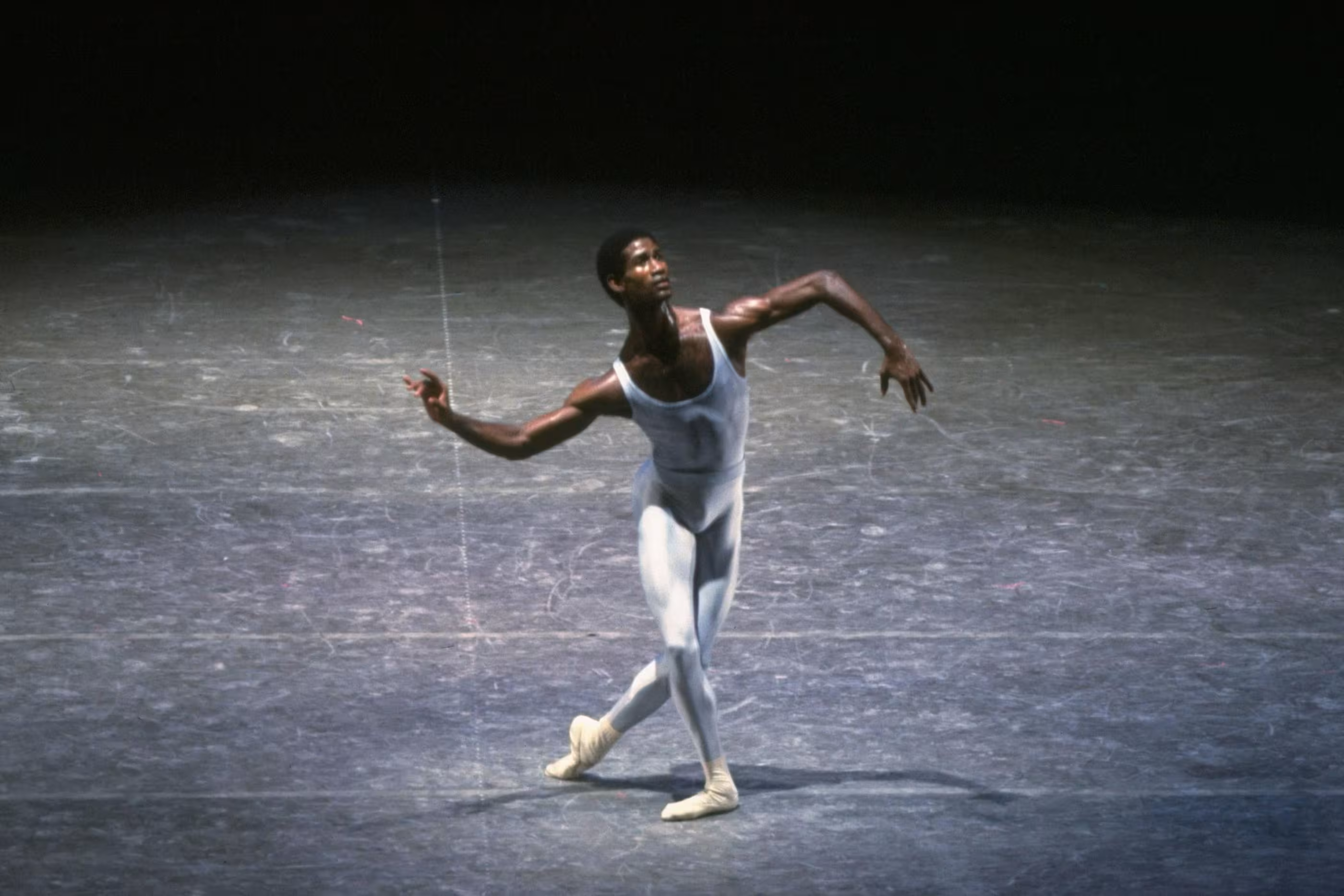


PhotoConcertino (Tomlinson, 1982) © Martha Swope. Courtesy of the Billy Rose Theatre Division, New York Public Library for the Performing Arts
One section of the Four Chamber Works, this fleet and angular trio captures Stravinsky's neoclassical wit in three compact dancers. The juxtaposition of the chamber ensemble with solo clarinet gives the work a sense of competitive play and intimate conversation.
Can be performed as part of Four Chamber Works or independently.
Choreography: Jerome Robbins
Music: Igor Stravinsky
Costume Design: Lawrence Miller
Set Design: Lawrence Miller
3 dancers:
1 woman
2 men
“Robbins has attempted to give the ballet a semblance of continuity by loosely placing it in a circus….Where Robbins has been particularly adroit in this work–which clearly delighted a relieved audience waiting somewhat restively for the celebration to get rather more celebrationary–is in capturing the feel of chamber music….The ballet has the right sense of intimacy–of wit and emotion privately displayed in a side room….A trio for the Concertino and Three Pieces for Clarinet was choreographically the work’s highlight….Deft, imaginative, it made the music the springboard for cool and civilized dances at a classically select gathering.”
“It was delightful....Five dancers in white were light and airy but elegant dancing to Septet….In Ragtime, Heather Watts, as a vamp, and Bart Cook, with slicked-down hair, were adept and amusing….Sean Lavery and Mel Tomlinson were crisp and modern maneuvering and lifting Merrill Ashley through the jagged rhythms of Concertino and the fast notes of Three Pieces….Four enthusiastic young men who usually act like they’re in the circus danced the bright finale to the 16-minute Octet. They kidded around, exercised, practiced high wire, unicycle and bareback tricks then went into some balletic moves, including mimicking girls being swans.”
“The best new choreography so far in the New York City Ballet’s continuing Stravinsky Centennial Celebration….It is an instant crowd-pleaser….He has come up with the conceit that all his dancers are circus performers. This is not an original idea, but its degree of stylization is….Eventually, one predicts Concertino, the superbly imaginative third section, danced with sensational flair by Merrill Ashley, Sean Lavery and Mel Tomlinson, will be used in the repertory by itself….Concertino is like a rocket blast.”
“The forty-five minute ballet–really four separate pieces under two wisps of circus trapeze–works best at its most outgoing. The more ‘abstract’ formalities of the first and third parts (Septet and Concertino) seem unconvinced of the force in Stravinsky’s late atonal impudence. Robbins responds to the earlier, jazzier Ragtime and Octet from 1917-22. Their personalities bring out his own.”
“There appeared a wonderful new ballet by Jerome Robbins–maybe one of his best. It’s called Four Chamber Works, and that’s what it is–four unrelated little ballets set to Stravinsky chamber pieces. Unpretentious, inventive, not at all forced.”
“Jerome Robbins’ four-part contribution to New York City Ballet’s Stravinsky Centennial Celebration turned out to be much like the celebration as a whole: it was one-quarter serious and successful invention (Concertino), one-quarter permutation (Septet), and two-quarters padding. The padding consisted of Ragtime and Octet; they seemed irrelevant not because they were the two lighthearted sections but because Robbins had overextended the gags. In the 1920 Ragtime, the gag didn’t go much beyond the 1920s costumes. Excessive fooling in Octet undermined the spirit of the music.”
“Four Chamber Works was both a set of miniatures and a curiosity. It consisted of separable ballets for small casts to five chamber compositions (one choreographic section employing two different scores)….The finest choreography occurred in the third episode, to Concertino and Three Pieces for Clarinet Solo. Here, Robbins juxtaposed darting steps for Merrill Ashley, Sean Lavery, and Mel Tomlinson with passages in which Ashley went limp and was twisted and tugged by the men….Four Chamber Works itself came to an end with Stravinsky’s Octet serving as a pretext for horseplay–some of it too self-consciously cute–for four boys.”
“A good deal more interesting than any other of the new works, it nevertheless had no hint of box-office success until the final section, the Octet. Octet shows the old charmer at work again….There is no one funnier than Robbins….It’s also fun to see Stravinsky worked for slapstick, rather than wit….At first look Concertino was not as intense as I think Robbins intended it, nor did three subsequent solos extend the personalities of the dancers beyond the obvious. In light of the Balanchine repertory, Concertino is possibly redundant. Yet I much look forward to seeing it again.”