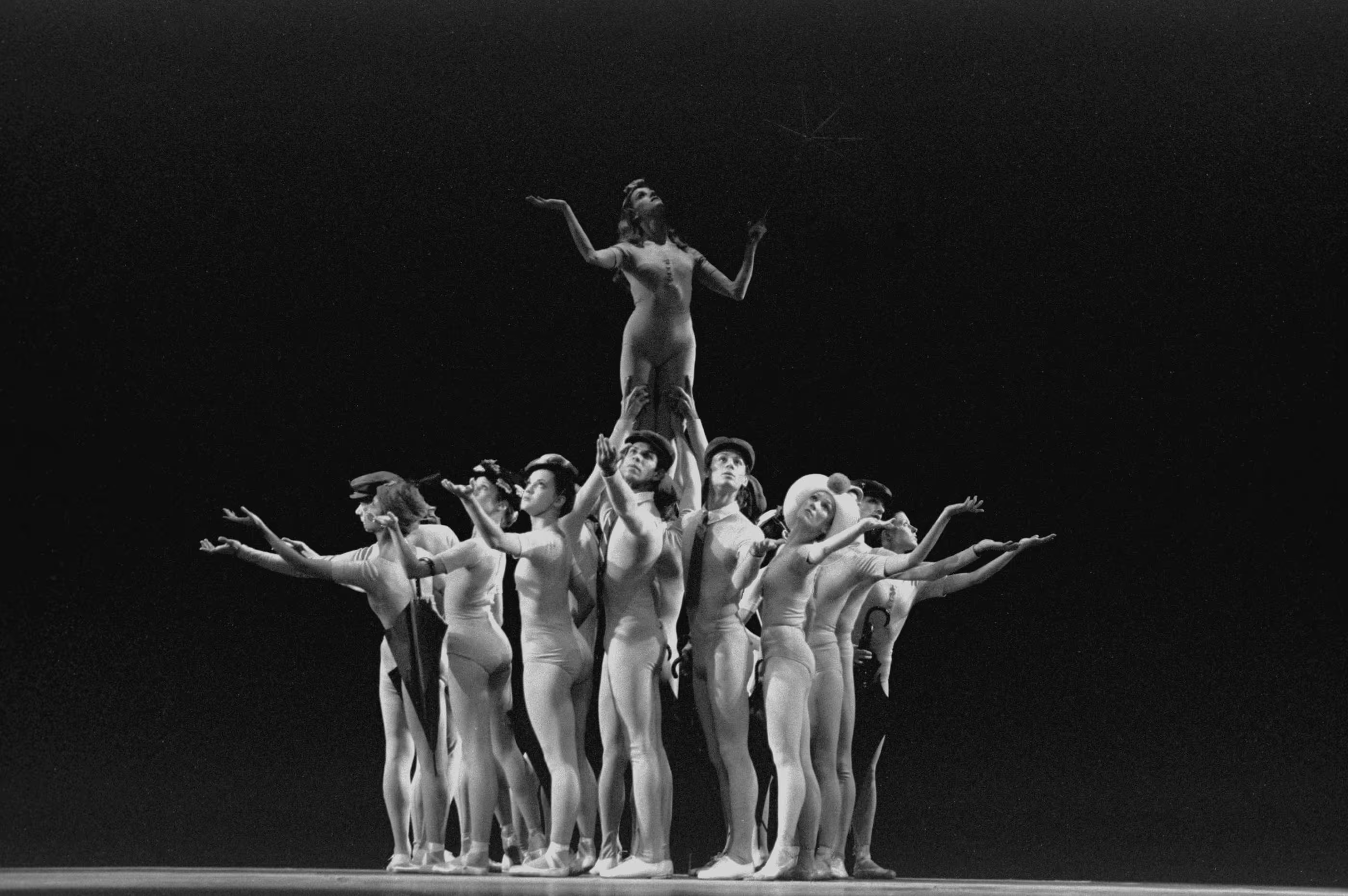

PhotoThe Concert (Leland, 1972) © Martha Swope. Courtesy of the Billy Rose Theatre Division, New York Public Library for the Performing Arts
This hilariously observed comedy of concert hall manners sends audience members drifting into increasingly absurd Chopin-induced daydreams: murderous fantasies, butterfly hallucinations, and hat-obsessed adagios. One of the funniest ballets ever made, and endlessly beloved.
Special Requirements
Piano on stage
Choreography: Jerome Robbins
Music: Frédéric Chopin
Costume Design: Irene Sharaff
Lighting Design: Jennifer Tipton
Set Design: Saul Steinberg
21 dancers:
10 women
11 men
“The work is an ingenious piece of spoofing that could stand trimming….Funniest of all last night were the moments when the dancers were just straight-faced fluffing turns, falling out of line, solemnly trotting back. This is one ballet company that can untangle any snarl of its own making and tidy up the wildest confusion with bland casualness….Those places were superb last night–the abrupt and casual fade-outs, the poker-faced apathy in the midst of chaos, the filing in and out of idle figures.”
“Robbins never overplays a joke or mimics in bad taste–but always with a light touch that is as affectionate as it is sensitive….Altogether, it is a sparkling charade, endearing and enjoyable.”
“Though Chopin undoubtedly flipped in his grave, the audience howled and howled.”
“According to the program note, it is a take-off on fanciful sobriquets such as ‘The Minute Waltz’ and ‘The Butterfly Etude,’ together with all the other personal ‘interpretations’ read into music by a concert audience. Actually the piece is a kind of nightmarish revue, in which a series of characters maintains the same relationships through an endless sequence of different situations….It starts out to be quite the funniest ballet that has been seen in modern times, but too much soon gets to be enough, and before it comes to an end it has knocked itself out by its sheer persistence.”
“Things got off to a fine beginning when Tanaquil Le Clercq, stirred to the depths by the music, launched herself into a whirlwind of action, with hair lashing, her face and her feet trying desperately to keep pace with the music until complete collapse struck her….In spite of its empty episodes, The Concert is certainly worth salvaging, for its best scenes are as funny as anything to be found in the theater of dance.”
“Taking a dozen assorted piano works by Chopin, Jerome Robbins has allowed the music to carry his fancy far and wide, somewhat in the manner of his delightful Pied Piper. The new ballet is overlong and uneven, but much of the time it is both funny and oddly touching….There is really no adequate way in which to describe Robbins’ exhilarating creation. You’ll just have to see for yourself.”
“Programmed as A Charade in One Act, it is a mad and often hilariously amusing satire….There is a most inventive use of a sort of processional for the ensemble with the opening and closing of umbrellas making an exciting stage picture. However, there are one or two slapstick sequences and several black-out skits that over-extend the whole idea and just don’t come off at all. Cut to at least half its length, all of this could be great fun, although, at that, it might be more at home in a Broadway theatre than on a ballet stage.”
“It is a New Yorker-ish joke (with pretty drops by Steinberg) about what goes on in people’s minds at a Chopin recital. Much of the joke is in the dancer’s deadpan reaction to the farcical situations they get into….The thing about Robbins is that he has a mind and he has a touch. He dreams up something titanic, but he dishes it out to you with a light hand, real cool. To have ideas, to invent; to have theatre sense, the know-how; and to be reticent withal, seeing when to stop; surely this is greatness.”
“The only serious utterance in The Concert was relegated to Tanaquil Le Clercq, who had a lovely introspective Mazurka solo with folding extensions and soft pawings of the floor. More than Balanchine himself, Mr. Robbins understands Miss Le Clercq’s dancing body….One aspect of the New York City Ballet that remains constant is its good breeding. In its essence, ballet is a theatricalization of social gesture. And the New York City Ballet dancers, perhaps because of Balanchine, never forget this….They are part of a pattern as orderly and as gracious as the courtly atmosphere that originally gave rise to ballet.”