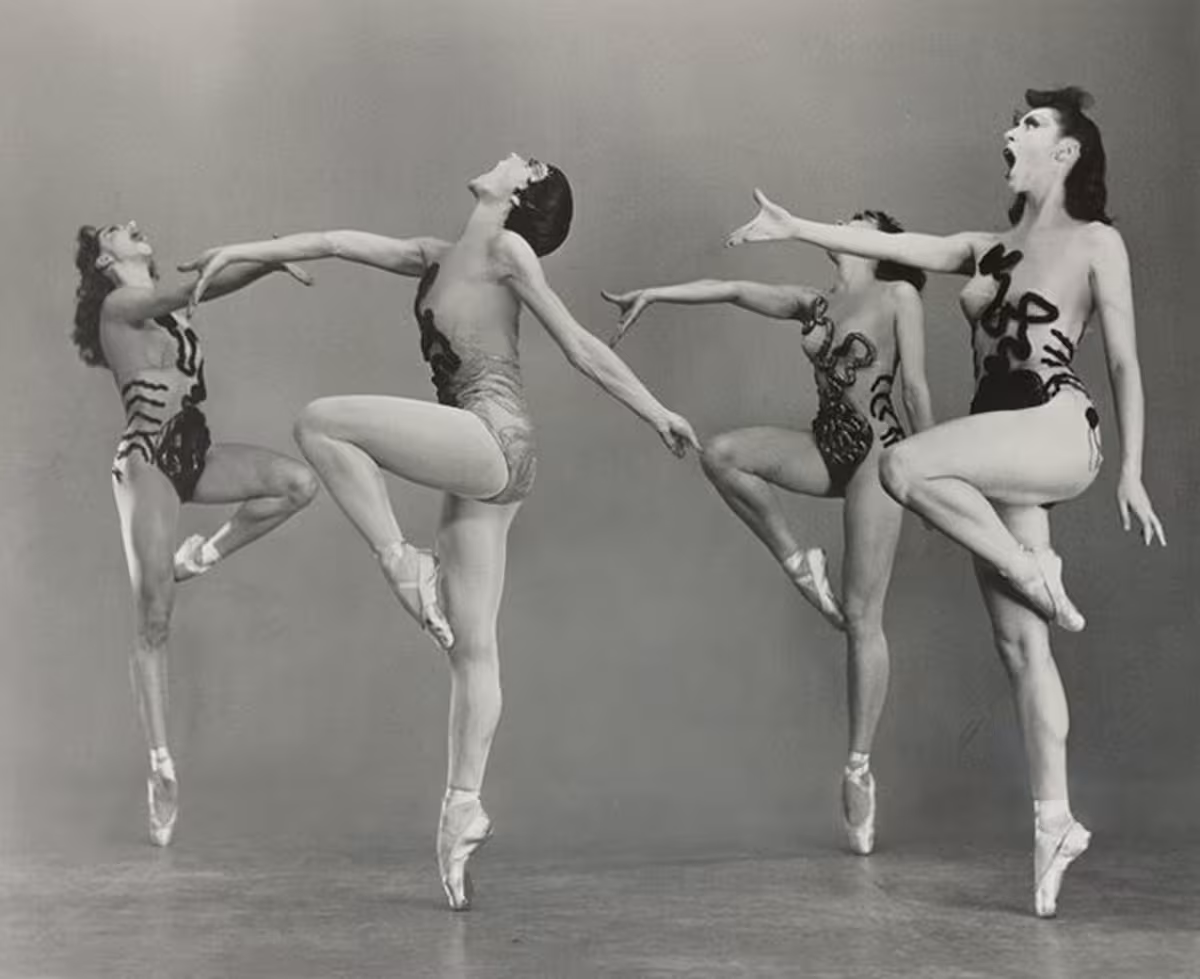


PhotoThe Cage (Kaye, Mounsey, 1951) © Martha Swope. Courtesy of the Billy Rose Theatre Division, New York Public Library for the Performing Arts
A provocative and visceral work — part praying mantis fable, part feminist allegory — in which a newly hatched female creature is initiated into a society of women who kill the male intruders who enter their world. Shocking and formally stunning when it premiered in 1951, The Cage remains one of Robbins' most powerful and discussed works.
Choreography: Jerome Robbins
Music: Igor Stravinsky
Costume Design: Ruth Sobotka
Lighting Design: Jennifer Tipton
Set Design: Jean Rosenthal
16 dancers:
Principals: 1 woman, 1 man
Soloists: 1 woman, 1 man
Corps: 12 women
“Neither the subject nor the ballet is pretty. Through his individuality of style, Robbins has accentuated the preying instinct with sure regular strokes. The atmosphere is charged: the action is tense. Given a dynamic crisp performance, the effect is powerful, even horrifying.”
“It is easily the most important work of the season….It is an angry, sparse, unsparing piece, decadent in its concern with misogyny and its contempt for procreation….Its characters are insects, it is without heart or conscience, and its opinion of the human race is not a high one. But in spite of the potency of its negations, it is a tremendous little work, with the mark of genius upon it….The movement is wonderfully conceived, both in its relation to the impulses of the body and in the tautness of its phrase.”
“The choreography proves conclusively enough that the way the female destroys the male is by…er…uh…well, maybe you better see it yourself….All in all, The Cage can be accepted as Robbins’ most typical ballet for Nora Kaye since Facsimile.”
“Mr. Robbins’ ballet does not specify the insect, the animal or the human, although attributes of each are indicated in the movements. Rather is his work a primitive ceremonial which celebrates with a certain aloof frenzy this terrifying digression from the accepted social pattern of modern man….Mr. Robbins, in this The Cage, has created a startling, unpleasant but wholly absorbing theater piece. The movements, with few exceptions, are not only pertinent to the theme but they drive its meaning to the fore with passion and clarity.”
“The Cage is a melodramatic novelty, and as such it’s rather effective. Its most novel aspect is the use of Igor Stravinsky’s String Concerto in D for its music. This was a delightful idea, for the nervous and rhythmical picking and sawing of the strings, especially in the final movements, is amusingly suggestive of insect activity–a fact I don’t suppose occurred to anybody before Robbins….A sportive new work, on the whole.”
“Jerome Robbins’ The Cage is a wild, frenzied, violent, unrelieved rite….In this work, which requires more analysis than we have room for at this writing, Miss Kaye is superb in a grotesque movement pattern, exciting for its primitive abandon and archaic movements.”