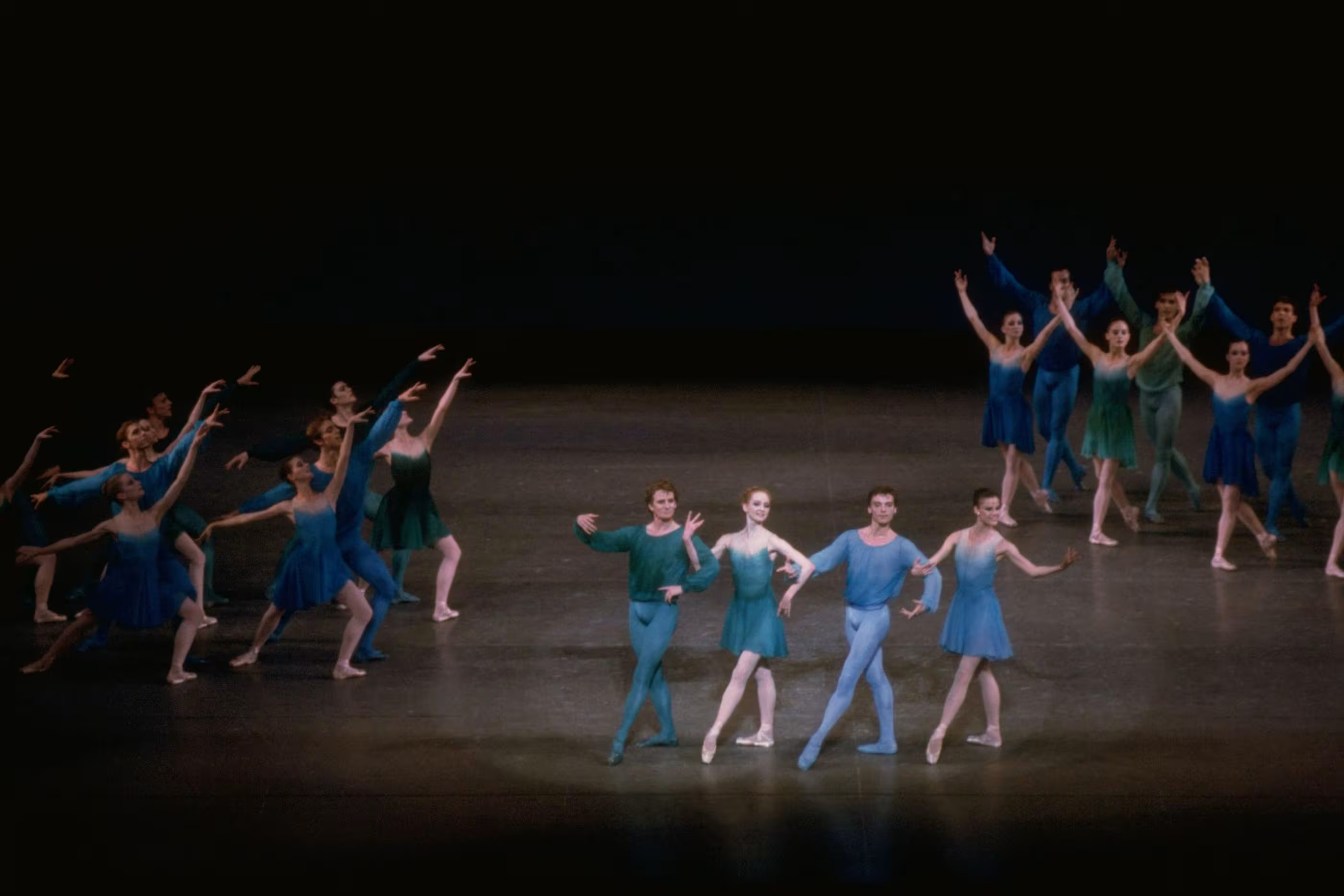


PhotoBrahms Handel (Cook, Calegari, Andersen, Ashley, 1984) © Martha Swope. Courtesy of the Billy Rose Theatre Division, New York Public Library for the Performing Arts
A collaboration between Jerome Robbins and Twyla Tharp in which the two choreographers each claim half the stage and half the company, ultimately braiding their signature styles into a single vision. Two worlds — Robbins' architectural classicism and Tharp's buoyant vernacular — collide and coexist with exhilarating wit.
Choreography: Jerome Robbins and Twyla Tharp
Music: Johannes Brahms
Costume Design: Oscar de la Renta
Lighting Design: Jennifer Tipton
28 dancers:
14 women
14 men
“I have no idea who did which, or who did what, but it has emerged as a most beautiful ballet, wandering stylistically in a world of its own imagining….You have never seen Tharp more disciplined or better danced. Then you have never seen Robbins more inventive. It must have been 50-50….The dancers move like magic, and whether they were moved by Robbins or Tharp, who can tell? They moved. It was magic....The work emerges as a seamless freefall and it will be a work that will remain in the repertory for years. It has the essential quality of character.”
“Brahms/Handel, which was co-choreographed by Jerome Robbins and Twyla Tharp, is really something new–radical in its break with rules of genteel ballet sensibility, as exciting as it is also flawed. Everyone should see it….The choreographers, for all their evident high seriousness, have decided to have some fun with some fun music….They come up with some outrageous images in this plotless movement extravaganza; they show off to prove how clever they are–and they are….Where they meet on the same ground is in their thirst for exploration of new movement and a visualizing of movement in a new context.”
“Though it is tempting to identify various passages as typical of Mr. Robbins and others as typical of Ms. Tharp, the piece gives the impression of having been conceived from the start as a totality….While it is, of course, possible that a number of the most remarkable effects in Brahms/Handel are the work of Mr. Robbins, his previous ballets suggest otherwise….The virtue of Brahms/Handel is that, while it suffers from few of Mr. Robbins’s weaknesses, it displays most of Ms. Tharp’s strengths, her passion for the daring exploitation of movement and for enlarging the capacities of her dancers.”
“Robbins’s role in this collaboration seems modest, even self-effacing. His choreography serves as a kind of backdrop in front of which Twyla Tharp can work. If he is presenting the dancers as they are, she is drawing from them what they might become….Yet there’s nothing so simple as a strict division of styles here; rather, the choreographers have created the same effect as the music, in which distinctive voices are continually layered atop one another, surrendering their prominence but not their personality.”
“The variations aren’t attributed, so we have to guess who did what. This makes a fascinating puzzle; after an obvious opening section by Robbins and after Tharp has staged an obvious entrance, the pace gets faster and the guessing gets tougher….The ballet has a remarkable stylistic unity, but because excess is part of Tharp’s makeup (and caution is a part of Robbins’) it seems to be more her ballet than his….These are all happy dancers, and this is choreography they cherish.”
“The choreography is dense, with the impetus of Robbins and the sudden quirkiness of Tharp. Yet it is impossible to tell where one starts and the other ends. The mood of the work comes from Edmund Rubbra’s juxtaposition of old and new, and the company move through it with amazin’ grace.”
“One would be hard put to identify categorically who did what in Brahms/Handel….Certainly the collaboration seems to have put both choreographers on their mettle; the ballet is riotously, even bewilderingly inventive, the wittiest, most invigorating piece of new choreography the company has had since Mozartiana.”
“The Robbins/Tharp partnership seems to have been one of friendly competition. There is a gang of dancers in aqua, led by Merrill Ashley and Ib Andersen, and a gang in emerald, led by Maria Calegari and Bart Cook….Rumor has it that Robbins made the choreography for the blues and Tharp for the greens, and the styles of dancing reflect that: the blues use the stage as a space for architecture, the greens treat it as an arena for the play of dynamic forces.”