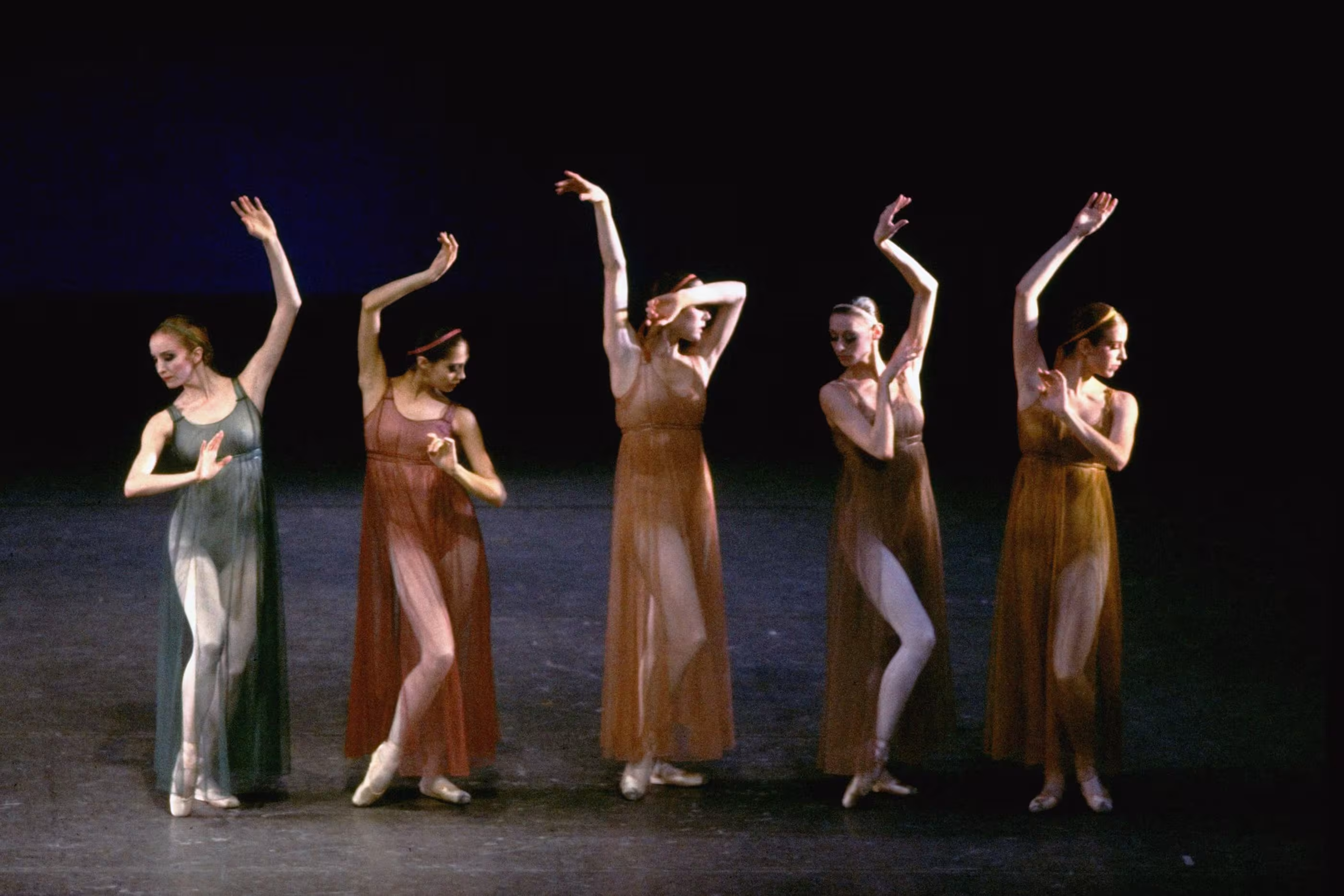


PhotoAntique Epigraphs (Nichols, Saland, Calegari, Schumacher, Alexopoulos, 1984) © Martha Swope. Courtesy of the Billy Rose Theatre Division, New York Public Library for the Performing Arts
An all-female work of Hellenic stillness and beauty, evoking the world of ancient Greece through Debussy's shimmering orchestral textures. Eight women move in flowing, archaic poses and slow sculptural patterns, conjuring the mystery and serenity of antiquity.
Choreography: Jerome Robbins
Music: Claude Debussy
Costume Design: Florence Klotz
Lighting Design: Jennifer Tipton
8 women.
“Robbins’ dancers look much like the figures on a Grecian urn, though their presence and movement is fully three-dimensional. From the opening tableau, with the eight women standing in a single vertical line up and down the stage, the piece moves between stylized poses and flowing, kaleidoscopic movement.”
“Its nature, in fact, is to be other than what first appears….It is not, for instance, really about Ancient Greece despite its pictorial references….Nor is it meant, one suspects, to evoke the Greece of Mr. Robbins’s imagination. Rather, the ballet embodies a filtering of several levels of sensibility–a choreographer musing on the music of a composer inspired by a poet’s view of antiquity. It is here that the ballet is true to its sources….The predominant dance idiom is that of classical ballet, but it is deliberately restricted.”
“Antique Epigraphs is laden with riches. Some of those riches come from the richness of resonant allusions, both musical and choreographic. Its surface simplicity shields a knowing complexity….The choreography, like the music, proves sensuously slow-paced–its dancers caught in an eternal summer. The movements–often metachronally sequential like breezes through a cornfield–and the grave, consciously self-conscious poses–are suggestive of both the Greece of mystic legend and yet, at the same time, carry a warm suggestion of peasant reality….All eight women are like muses who have acquired the still secret of poetry.”
“It was merely a pretty world that he showed us–one uncertainly situated in time. Was this the Greece of the Belle Époque, was it the Greece of early American modern dance, or was it the historical, unimaginable Greece? The ballet suggested a little of all three.”
“Antique Epigraphs is a work of seemingly flawless invention, whose brevity and clarity are factors in its immediate appeal. It is much like Ashton’s Monotones, in that, despite its deliberately slow-paced dancing, it flashes by all too quickly. Nevertheless its unique atmosphere and evocative dance images, like Ashton’s, linger in the mind….It is difficult to put into words the ballet’s special qualities and nuances….One can note that the still poses, the linked arms of the ensemble bring to mind the friezes found on Grecian pottery, but none of that conveys why the ballet is so strangely moving.”
“Antique Epigraphs is self-consciously small….It’s understatement written in neon, where one becomes aware of Robbins–and the dancers–straining for modesty….As always, Robbins’s eye for gentle symmetry is unerring, gorgeous; and as sometimes happens, the asymmetry draws too much attention to itself….Besides drawing pictures, Robbins describes an atmosphere. It’s a puzzling one….They seem summoned, though somewhat unhappily, to a fate; indeed, Robbins uses the ‘Syrinx’ flute solo as the beckoning call. To what, we don’t know, but the flute gathers these heretofore scattered nymphs into a cohesive sorority, and off they saunter into the sunset–pensively, pensively.”